

Jukeboxes and Their Use of Vinyl Records
After the decline of wax cylinders at the turn-of-the-century, jukeboxes used vinyl records to play their music.
This type of technology is analog, meaning that there needs to be a needle reading physical grooves in a vinyl disk in order to play music. Over time, this needle would lead to wear and tear on the vinyl record, eventually causing significant damage to sound quality.
Furthermore, records are large and prone to cracking, and also sensitive to heat, humidity, and dust.
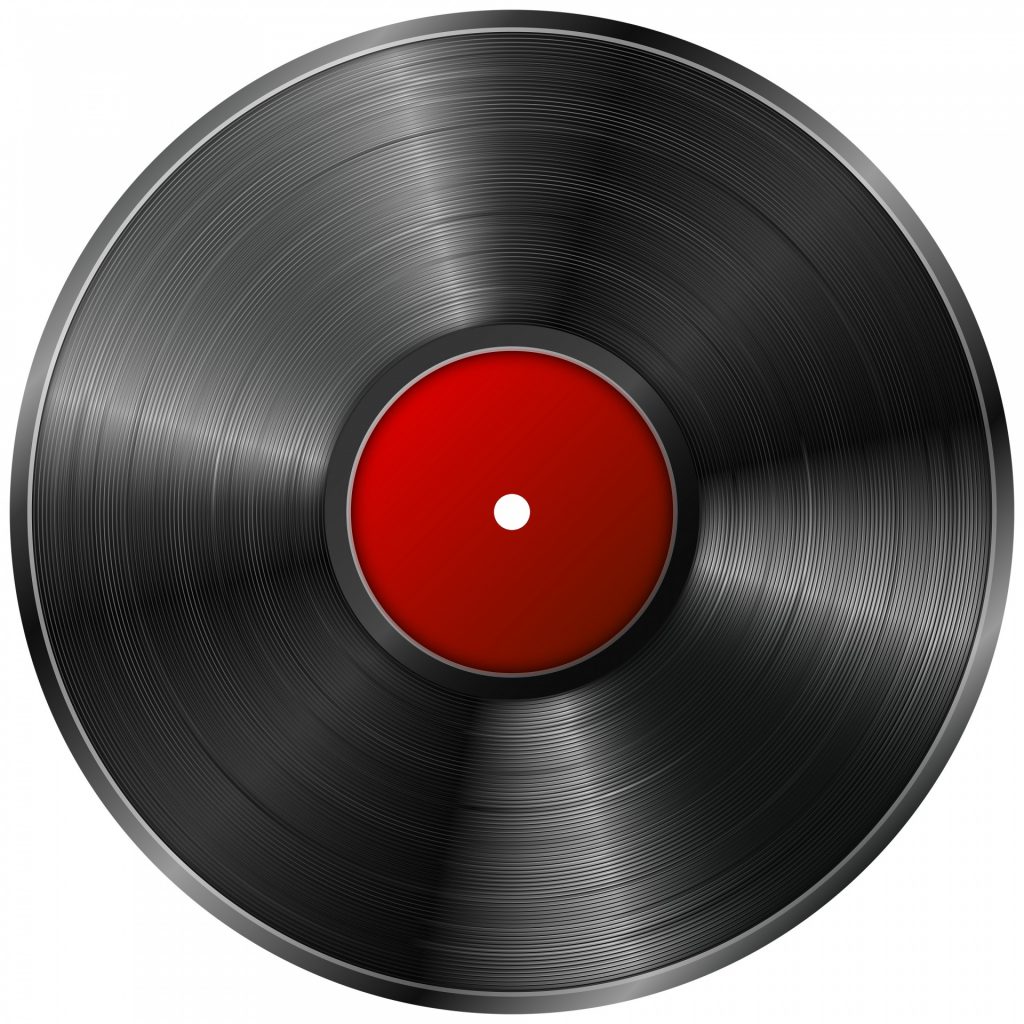
A Vinyl Record
Paul Brennan. “Vinyl Record Isolated Free Stock Photo – Public Domain Pictures.” (Free Stock Photo – Public Domain Pictures.) Accessed October 30, 2019. https://www.publicdomainpictures.net/en/view-image.php?image=175355&picture=vinyl-record-isolated.
While these problems could be dealt with and overlooked at the height of the jukeboxes’ popularity, when new alternatives were introduced, it did not take long for the jukebox to fall out of fashion.
New Technologies: What Made the Jukebox Obsolete?
The Compact Disc (CD)
One of the technologies that started to compete with the jukebox was the compact disk, commonly known as the CD. Hitting the markets in 1982 through a partnership between Sony and Phillips, the CD radically changed the way music was stored and played. [1]
Instead of using a physical needle to read information from the disc-like a traditional jukebox, the CD was read using a laser. Among other advantages of compact disks over vinyl records, the CD is more resistant to heat and humidity, and it has a much smaller physical profile. [2] Below is a photograph of the press seeing the compact disc for the first time.
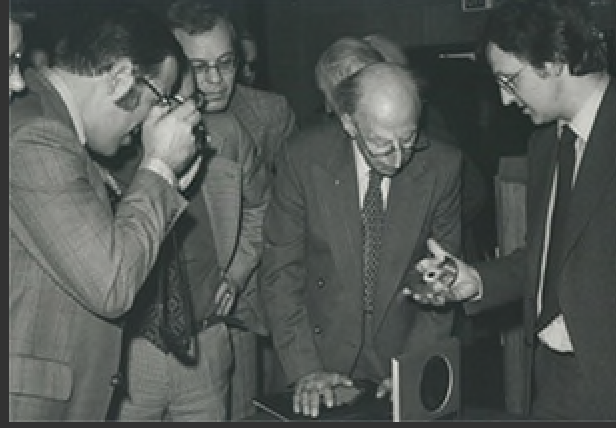
Members of the Press Hold a Compact Disc for the First Time.
“The History of the CD – The Beginning – Research.” (Philips.) Accessed October 30, 2019. https://www.philips.com/a-w/research/technologies/cd/beginning.html.
Because of the smaller profile of the CD, music was more portable than ever before. Soon after its emergence, companies began introducing handheld CD music players.
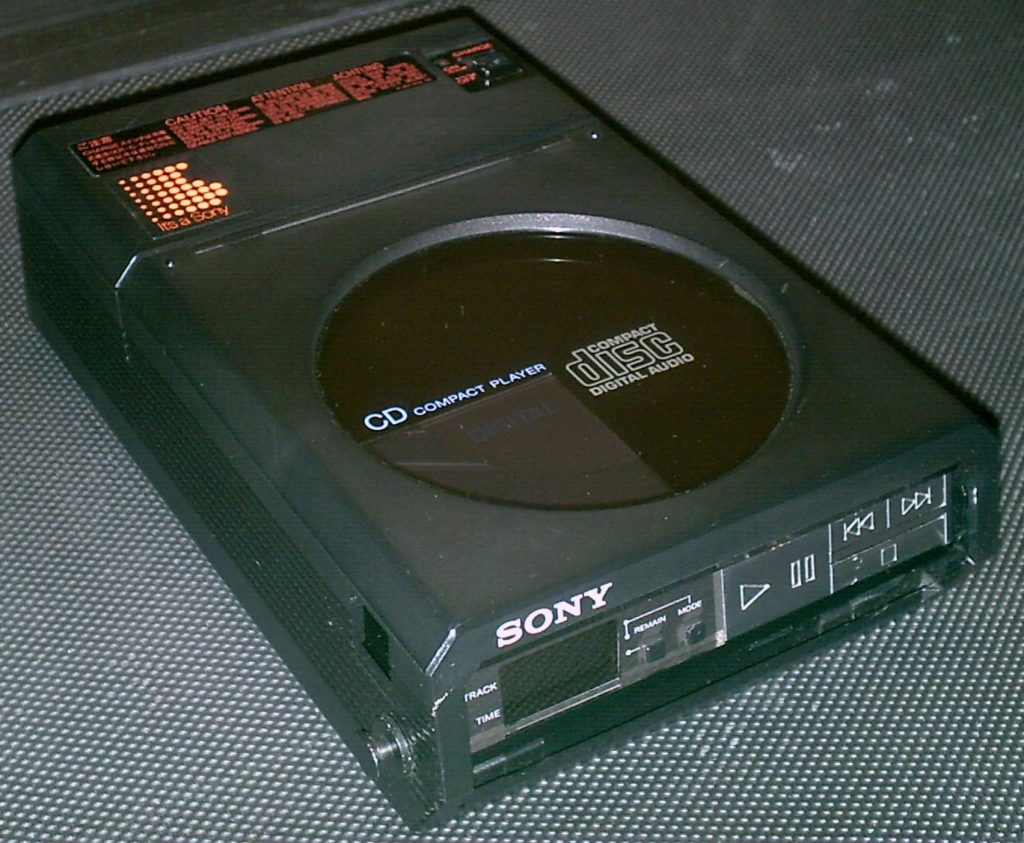
A Sony CD player
“Sony CD player.” (Wikimedia Commons.) Accessed October 30, 2019. https://commons.wikimedia.org/w/index.php?title=Special:Search&search=sony+cd+players&fulltext=1&ns0=1&ns6=1&ns12=1&ns14=1&ns100=1&ns106=1#/media/File:Sonyd50.JPG.
In contrast, the jukebox was still large and cumbersome, and could only play one musical selection for a large group of people. These new handheld CD players made it possible for individuals to take their music with them wherever they went.
Compact disk technology also found its way into the automobile industry. CD slots were added into vehicles for people to listen to music on the go. Now they had another option to listen instead of just the radio. [3] In the late ’80s, CD players became extremely popular in everyday vehicles. In a 1990 article from Billboard magazine, a Chrysler spokesman stated that he had seen “almost four times the amount of CD players being sold as options from the 1989 to 1990 model year”. [Ibid] Like the handheld version, the introduction of car CD players drastically changed people’s accessibility to music.
The MP3 Player and Digital Audio
The compact disk was revolutionary in that it made music more portable, but the MP3 player took this idea further. This device negates the need for any type of physical like vinyl or compact disk and instead uses completely digital audio files. One of the most notable examples of this is Apple’s iPod, which first released in 2011 and would later evolve into a number of portable, music-playing devices. [4]
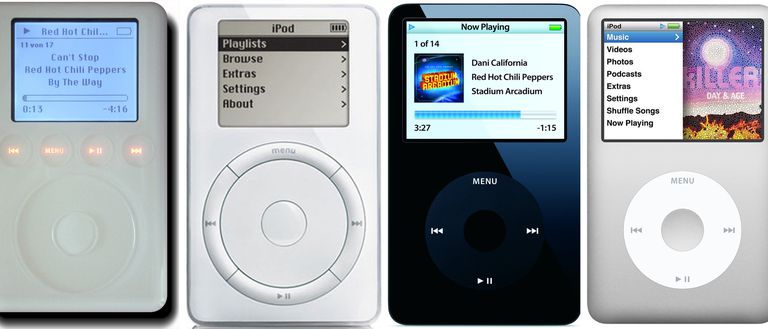
Apple iPods Over the Years
“iPod images via Apple Inc.” (Lifewire.) Accessed October 30, 2019. https://www.lifewire.com/history-ipod-classic-original-2000732
MP3 players typically use two types of memory, flash or hard drive. Both of these forms of memory are very compact and use very little power, allowing for extremely small designs with long battery life. [5]
Cultural Changes
While the jukebox was an early means of promoting choice in the music industry, nothing could compete with the level of individual choice offered by the CD and later digital audio. These new technologies following the jukebox shifted music from not only a group activity but an independent one as well.
Key Takeaways
Just as its development and rise to popularity took over a number of decades, the decline of the jukebox too, took a number of decades. Each of the music-playing, entertainment devices listed above offered an additional modicum of portability, personalization, and ease that the jukebox could not.
For the most part, the cassette tape, the compact disk, the MP3 file, and their respective devices were meant for individual – not community use, unlike the jukebox. These devices popularized a need in the music industry and in popular culture that was not yet being filled; the jukeboxes’ popularity was more focused on social behavior.
Notes
[1]“The History of the CD – The Beginning – Research.” (Philips.) Accessed October 30, 2019. https://www.philips.com/a-w/research/technologies/cd/beginning.html.
[2]“CD vs Vinyl Record.” Diffen. Accessed October 30, 2019. https://www.diffen.com/difference/CD_vs_Vinyl_Record.
[3] Nunziata, Susan. “Portable CD Player Market Seeing Runaway Success.” (Billboard 102, no. 7 February 17, 1990) 1. https://www.americanradiohistory.com/Archive-Billboard/90s/1990/BB-1990-02-17.pdf
[Ibid] Nunziata, Susan. “Portable CD Player Market Seeing Runaway Success.” (Billboard 102, no. 7 February 17, 1990) 1. https://www.americanradiohistory.com/Archive-Billboard/90s/1990/BB-1990-02-17.pdf
[4] Lanxon, Nate. “The Complete History of Apple’s IPod.” CNET, October 25, 2011. https://www.cnet.com/pictures/the-complete-history-of-apples-ipod/.
[5] “How Do MP3 Players Work?” Explain that Stuff, June 12, 2019. https://www.explainthatstuff.com/how-mp3players-work.html.