

The Contemporary Jukebox: Decline, Nostalgia, and Modern Versions
The Decline of the Jukebox: Beginning in the 1970s
While on shaky ground in the 1960s, the main decline of the jukebox can be traced to the 1970s. This is due to the production of other music-playing technologies, including the portable radio, cassette tape deck, and later, the CD and MP3.
To learn more about these competing technologies, please click here.
Because these inventions were portable and could travel anywhere, Americans had the ability to take popular music with them at all times. Instead of going to a restaurant or diner to listen to popular music, people could simply listen to their favorite bands and songs on a specific cassette tape.
In addition to purchasing their favorite music, cassette tapes also allowed for individuals to buy empty tapes and load their own favorite music or recordings – a function that jukeboxes did not have. As portable cassette tape decks and portable radios became more popular, jukeboxes became more scarce. [1]
Decline In Jukebox Production: Why did Companies Leave the Market?
There are many factors that contributed to the decline of jukebox production. One key factor is simply due to manufacturers leaving the business in pursuit of modern alternatives.
Pursuit of Alternatives
In 1974, Wurlitzer stopped producing jukeboxes after they released the 1050 model. Even so, this model was not lucrative enough to revitalize their role in the market, so the company left the market entirely – after decades of involvement with “automatic entertainers” and the jukebox.
Wurlitzer’s exit from the market caused the number of jukeboxes made to decline to only 25,000 a year globally. This is a significant decline compared the the almost 700,000 jukeboxes produced in the United States in the 1950s. [2]
The Jukebox: No Longer Economically Viable
As companies left the jukebox market in pursuit of modern alternatives, the existing jukeboxes themselves saw a steep decline in profit. By 1980, jukeboxes only made a profit of $49.95. This was due to an increase in the price of vinyl records coupled with peoples unwillingness to pay a quarter to listen to one song on the jukebox.
Further, royalty fees themselves had increased by $17 in the span of one year – adding the the overall increasing cost of the jukebox. [3]
Overall, the decline of the jukebox occurred because better, modern music-playing alternatives made the industry not profitable enough to be sustainable.
The “Modern” Jukebox
The “Return” of the Jukebox: Using New Technology
Despite the decline of the jukebox by the 1970s, it is still possible to see “modern” versions of the jukebox today. This is due to modern technologies being used to create “new” jukeboxes that lack visual similarities to their mid-century antecedents.

A TouchTunes Digital Jukebox
“TouchTunes and the New Angelina Jukebox – April 2018.” (RePlay Magazine, April 1, 2018.) https://www.replaymag.com/touchtunes-april-2018/.
TouchTunes Jukeboxes
In 1993, TouchTunes released one of the first completely digital jukeboxes that utilized a large touchscreen. Rather than standing alone, these jukeboxes were wall-mounted in restaurants, bars, and entertainment centers. Listeners could pick from a large number of MP3 songs downloaded to the box itself. [4]
Because of the cheapness of MP3 downloads, as well as the increased storage capacity of jukeboxes, TouchTunes was able to capitalize on these desirable factors to place jukeboxes back in restaurants, bars, and other social spaces.
Playing further on the modern technologies available at the time, TouchTunes made attempts to add other desirable features, such as photo booths, a karaoke set, and app-compatibility. In addition to TouchTunes, AMI also manufactures digital jukeboxes.[5]
The “Return” of the Jukebox: Using Old Technology
The jukebox did not just return because of the digitalization of these machines, vinyl records also caused jukeboxes to come back. Vinyl records were used in the jukebox because they were inserted in a specific numbered slot in the inner case of the jukebox. This allowed the user to select what record they wanted to be played based on the numbered slot.
As of 2018, vinyl record sales are at its highest sales point since 1988. [6] With vinyl records becoming more popular, this increased the production and sales of the jukebox. New companies started to produce jukeboxes that took the 70 x 7″ vinyl record, like Crosby. [7] Crosby started to manufacture the Crosby Rocket Full Size Vinyl Jukebox that allowed new vinyl records to be played on these old machines. [8] People liked the idea of using old technology, like vinyl records and jukeboxes. It was nostalgic for people.
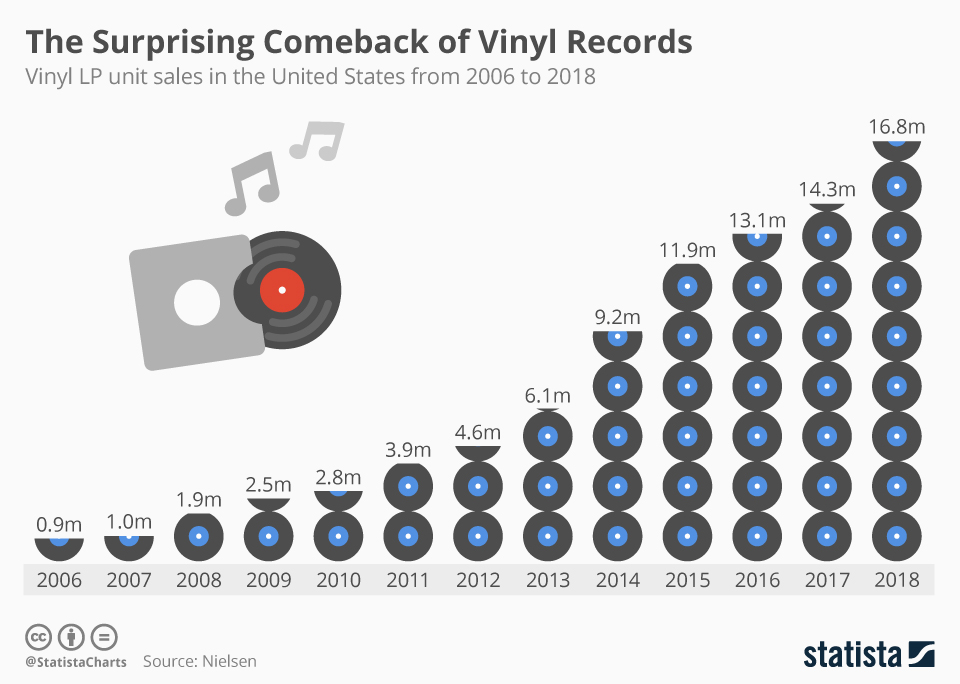
The Resurgence in Vinyl Sales Over the Years
Felix Richter. “Infographic: The Surprising Comeback of Vinyl Records.” (Statista Infographics, April 12, 2019.) https://www.statista.com/chart/7699/lp-sales-in-the-united-states/.
Manufacturers of the “Classic” Jukebox Today
While new, updated, digital jukeboxes are being produced, the classic jukebox is still being manufactured by certain companies, including Rock-Ola, Antique Apparatus, and AMI/Rowe. [9]
Rock-Ola
Rock-Ola produces a limited selection of Jukeboxes. In addition to producing classic jukeboxes, some new Rock-Ola jukeboxes are updated with CD slots, Bluetooth, and touch screens.
Further, the iconic “Bubbler” design is still in production, with versions being available that play both vinyl records and CDs. [10]
Antique Apparatus’ Wurlitzer Rendition
Antique Apparatus produces a rendition of the Wurlitzer jukebox. They manufacture a copy of the Wurlitzer Model 950 with its original vinyl record placement. [11]

A Reproduction Bubbler Jukebox.
“Antique Apparatus CD Jukebox.” (1stdibs) Accessed October 29, 2019. https://www.1stdibs.com/furniture/more-furniture-collectibles/collectibles-curiosities/musical-instruments/antique-apparatus-cd-jukebox/id-f_4890813/.
AMI
While AMI is a classic jukebox company, known for their model “the Tortoise,” they only produce digital jukeboxes today. These new jukeboxes include touchscreens, a credit card reader, and other modern features. [12]
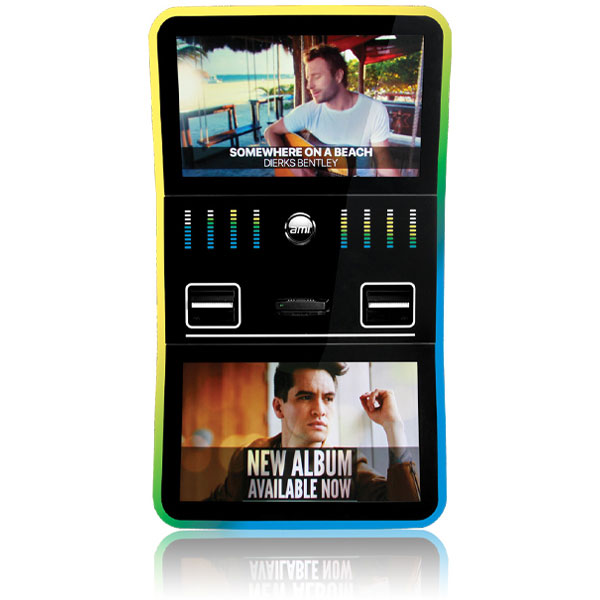
Another Digitized Jukebox
“NGX-32.” (AMI Entertainment.) Accessed October 29, 2019. https://amientertainment.com/classic-ngx/.
The Meaning of the Word “Jukebox” Today
While the word “jukebox” itself has a slightly muddled history, with debate existing over the exact origins of the meaning of the word “juke,” it has now come to be synonymous with a time of mid-century American popular culture.
In the literal sense, the word “jukebox” still refers to a “machine that automatically plays selected recorded music when a coin is inserted.” Nowadays, that can refer to using a credit card or even smartphone to select a downloaded MP3 file or a song on a music-streaming platform. [13]
In the figurative sense however, “jukebox” can now refer to that sense of popular culture from days past – such as the memory of listening to music with friends or family, or the bright lights and music that embody the 1950s.
Finding Jukeboxes Today: Digital Jukeboxes and Classic Artifacts
Today, various forms of jukeboxes can still be found throughout the United States.
Classic remakes can be found in diners, bars, arcades, and, of course, museums. Notable restaurants that still include these type of jukeboxes include Johnny Rockets and Silver Diner, both of which attempt to create a “retro” dining environment. [14]
Digitized jukeboxes, such as the TouchTunes model or that of AMI can mostly be found in bars or arcades.
Key Takeaways
While many jukeboxes live on forever in museums, “living” models can still be found today, both in select classic models, as well as the aforementioned digitized models made by TouchTunes and AMI/Rowe. The presence these jukeboxes, even if they are few in numbers and “just for fun,” is indicative of the strong impact held by the jukebox in American popular culture and memory.
Notes
[1] Associated Press. “The Jukebox, It Seems, Is a Hit of the Past.” (The New York Times, July 21, 1982) https://www.nytimes.com/1982/07/21/garden/the-jukebox-it-seems-is-a-hit-of-the-past.html.
[2] Ibid.
[3] Ibid.
[4] “TouchTunes.” TouchTunes. Accessed October 29, 2019. https://www.touchtunes.com/.
[5] Michele Lauren Jackson. “Digital Jukeboxes Are Eroding the Dive-Bar Experience.” (Atlantic Media Company, May 8, 2018.) https://www.theatlantic.com/technology/archive/2018/05/touchtunes-digital-jukebox/559784/.
[6] “Vinyl Rocket Jukebox with Bluetooth and Coin Box.” Crosley Radio. Accessed October 30, 2019. http://www.crosleyradio.com/jukeboxes/product-details?productkey=CR1210A&model=CR1210A-BK.
[7] Ibid.
[8] Team, VF. “Revenue from US Vinyl Sales Climbs to 30 Year High.” (The Vinyl Factory, March 1, 2019.) https://thevinylfactory.com/news/us-vinyl-sales-revenue-30-year-high/.
[9] Ibid.
[10] Ibid.
[11] “Antique Apparatus CD Jukebox.” at 1stdibs. Accessed October 29, 2019. https://www.1stdibs.com/furniture/more-furniture-collectibles/collectibles-curiosities/musical-instruments/antique-apparatus-cd-jukebox/id-f_4890813/.
[12] Ibid.
[13] “Music Network and Customer Engagement Platform.” AMI Entertainment. Accessed October 29, 2019. https://amientertainment.com/.
[14] “NGX-32.” AMI Entertainment. Accessed October 29, 2019. https://amientertainment.com/classic-ngx/.
[15] Suzanne Raga. “10 Retro, Rockin’ Facts You Might Not Know about Johnny Rockets.” (Mental Floss. December 01, 2015.) Accessed October 29, 2019. http://mentalfloss.com/article/71416/10-retro-rockin-facts-you-might-not-know-about-johnny-rockets