Barnes, Rhae Lynn. “Working Class Hero to Felon: Picking Apart the Banjo’s Cinematic Character Assassination in Postwar Mass Culture and Film.” Modern American History 7, no. 2 (July 1, 2024): 313–18. https://www-cambridge-org.umw.idm.oclc.org/core/journals/modern-american-history/article/working-class-hero-to-felon-picking-apart-the-banjos-cinematic-character-assassination-in-postwar-mass-culture-and-film/AC2BB4E6BD6CD5D0BE992ECAF10400D6.
This source describes the early American Banjo, and its role in portraying racial stereotypes against Black Americans in minstrel shows. It describes the perception shift from a “lowclass” instrument to the various ways artists went on utilize the banjo in later years.
Blount, Jake. “Jail the Zombie: Black Banjoists, Biopolitics, and Archives.” Modern American History 7, no. 2 (July 2024): 301–6. https://doi.org/10.1017/mah.2024.30.
This source details the banjo’s invention, from its African antecedants to the Caribbean sugarcane plantation social structures that allowed for the banjo to develop into a new shared cultural tradition among black people. The author explains the changes made to the instrument as it spread across America, then discusses the surviving recordings of black banjoists from the early to mid 20th century.
Conway, Cecelia. “Banjo.” Chapter. In Encyclopedia of African American Music: [3 Volumes], edited by Tammy L. Kernodle, Emmett G. Price, and Horace Maxile, 39–40. Santa Barbara, California: Greenwood, 2011. https://research.ebsco.com/c/mcjyvo/search/details/rj7mfbjp6r.
Conway, Cecelia. “Black Banjo Songsters in Appalachia.” Black Music Research Journal 23, no. 1/2 (2003): 149–66. https://doi.org/10.2307/3593213.
Conway explores the evolution of the banjo’s associations in music, from hillbillies to bluegrass and beyond. The text delves into the history of the instrument, from its African origins to its use by white minstrel performers to portray racist stereotypes.
Dubois, Laurent. The Banjo : America’s African Instrument. Cambridge, Massachusetts: The Belknap Press of Harvard University Press, 2016.
Dubois presents the banjo’s evolution throughout history, from its origins in Caribbean and American plantations to when whites appropriated the instrument for minstrel shows and began to produce it on an industrial scale. The source focuses on the community aspect of the instrument and how it has remained a staple in African American music.
Fulwood, Ethan L. “Quantitative Similarities between the Banjo and a Diverse Collection of West African Lutes.” Humanities & Social Sciences Communications 9, no. 1 (2022). https://doi.org/10.1057/s41599-022-01401-3.
This source uses quantitative methods to study the West African antecedents of the banjo, since there are many different types of lutes that likely contributed to the creation of the instrument.
Khalid, Farisa. “Henry Ossawa Tanner, The Banjo Lesson.” September 9, 2016. Accessed September 19, 2025. https://smarthistory.org/tanner-banjo/.
Through the lens of Henry Ossawa Tanner’s famous painting, Khalid discusses the history of the banjo and its impact on Tanner’s artwork.
Mazow, Leo G., Sarah Burns, Michael D. Harris, Joyce Henri Robinson, and Cecelia Tichi. Picturing the banjo. University Park, Pennsylvania: Pennsylvania State University Press, 2005.
This source is a piece of artwork that depicts a Black American holding a banjo on their knee. It is from the Smithsonian museum in the era after the Civil War.
Meredith, Sarah. “With a Banjo on Her Knee: Gender, Race, Class, and the American Classical Banjo Tradition, 1880-1915.” Dissertation Abstracts International. Proquest Info & Learning Co, 2006.https://research.ebsco.com/linkprocessor/plink?id=9f359450-3a2e-3474-ac52-7c247986bcc3.
This source discusses how women were able to popularize the American Banjo to white audiences due to gender ideologies of the time period. It states that by studying the banjo, we learn about race, gender, and class relations of the nineteenth century.
Stimeling, Travis D. “Well of Souls: Uncovering the Banjo’s Hidden History by Kristina R. Gaddy (Review).” Notes (Music Library Association) 80, no. 2 (2023): 346–48. https://doi.org/10.1353/not.2023.a912355.
This source goes into the roots of the banjo, exploring the roots found in various places in the world. Gaddy relies heavily on diaries, journals, and artistic renderings for her research, acknowledging the implicit ethnocentrism in primary sources of the time.
Thompson, Joseph M. “Five Strings for Freedom: The Banjo in Cold War America.” Modern American History (Cambridge.) 7, no. 2 (2024): 307–12. https://doi.org/10.1017/mah.2024.32.
Thompson delves into the intricacies of how the banjo has been used as a quintessentially “American” instrument, especially during wartime. The banjo has always been rooted in resistance and community, so this source indicates how that association has evolved over time and the different was the banjo has been used for protest.
Thornton, Ramsey. “Affrilachian Banjo Lineage: Its Archaeological Trail, Instances of Black/White Exchange, and Lasting Legacy.” Order No. 30575206, Oklahoma State University, 2023. https://umw.idm.oclc.org/login?url=https://www.proquest.com/dissertations-theses/affrilachian-banjo-lineage-archaeological-trail/docview/2910062412/se-2.
This source traces the origins of the American Banjo, specifically delving into the history of cultural exchange between black people and white people. After dedicating research to the early African banjo the study then discusses the white adoption of the instrument.
Winans, Robert B, and Elias J Kaufman. “Minstrel and Classic Banjo: American and English Connections.” American Music (Champaign, Ill.) 12, no. 1 (1994): 1–30. Minstrel and Classic Banjo: American and English Connections on JSTOR
This source describes the evolution of the banjo in America, and how the instrument was popularized in the United States. It explains how variations of the American Banjo emerged in Europe and how English Banjos had a distinct style musically.
Research Proposal
For our project, our group all agreed that we were interested in studying the history of a musical instrument, since we hadn’t seen any previous groups choose to study an instrument and we all found the topic interesting. After searching for different instruments, we settled on the banjo because of its strong association with American culture, making it an incredibly fitting topic for our documentary and project. All three of us were already somewhat familiar with the instrument, but we did not have any background knowledge on the instrument itself, its invention, history, or antecedents other than the fact that it is viewed as a southern American instrument. We were interested in learning more about how the banjo emerged as the icon in Bluegrass and Country music that it is today.
While the modern banjo is viewed as quintessentially American, the banjo actually developed from West African stringed lutes such as the ngoni, xalam, and kora. After the establishment of the Transatlantic Slave Trade, West Africans enslaved in Caribbean sugar cane plantations developed new instruments based on the lutes from their own cultures. They used gourds and calabashes to create the body of the instrument and animal hides to create the head. In part due to the invention of a new shared instrument, enslaved Africans were able to develop a sense of community in spite of the horrific conditions they faced at the plantations.
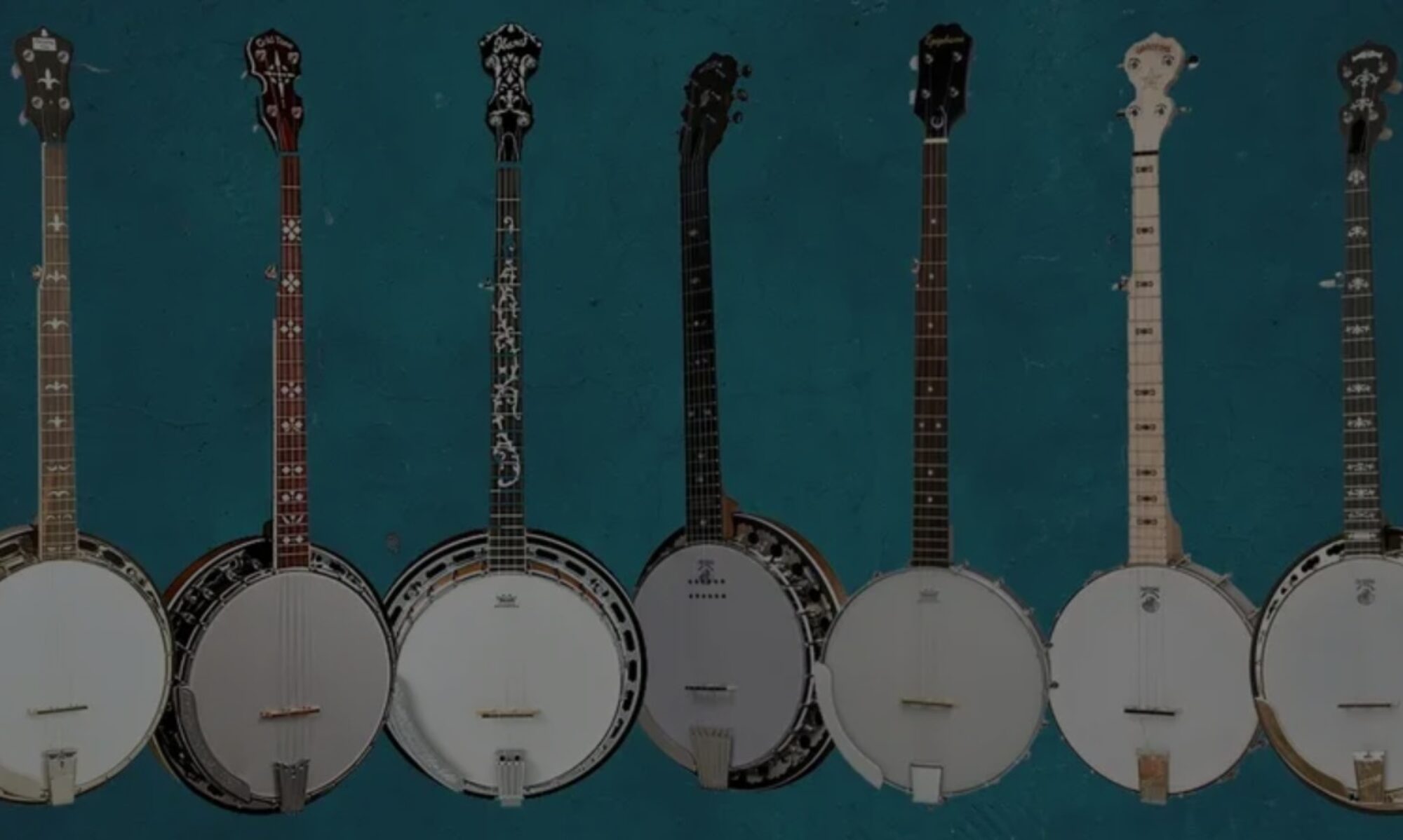
The banjo soon spread to the United States by the 1730s, where the design evolved to utilize synthetic materials, wood, and steel. The instrument began to be produced on an industrial scale, allowing more communities to have access to it and adopt it into their own music. However, despite its invention being owed to enslaved Africans, the banjo was appropriated by white Americans and used to portray racist stereotypes in minstrel shows. Publishers sold banjo guides for minstrel show performers until 1970. In addition to teaching readers about the instrument, the guides also portrayed stereotypes of Black Americans. The banjo was widely viewed as a “lowclass” instrument, and wasn’t taken seriously due to its role in minstrel shows. As white southerners began to play the instrument, the American Banjo gradually became more accepted seriously, and was attributed to white, rural, southern culture rather than black culture. Artists in the South were largely influenced by Black culture, but were credited with the invention and popularization of the five string banjo. Americans popularized the banjo in Europe through minstrel shows. By the 1860s, distinct English banjos emerged that were physically different from the American Banjo. These alternative banjos often had six, seven, or even nine strings.
We have decided that we will not be using AI in any way while creating this project, in part due to shared moral objections to AI and also due to our desire to keep this project as a creative endeavour that is entirely our own work. While we believe that AI can be useful in certain instances, we all agreed that we wanted to focus on creating this project purely from our own research and creative ideas rather than using AI to produce drafts or ideas of our work for us.
As for the documentary section of this project, we will be using a professional camera from the HCC to film. After we finish our recordings, we will edit our footage using either Microsoft Clipchamp, Canva, or both, depending on which program we find best suited to our skills. Since we do not have much prior experience with video editing, we will likely visit the HCC throughout the process in order to get pointers and advice for the process of documentary creation. We also do not have much experience with website creation, but we hope to learn more throughout the process of this project and we will continue to gain skills in digital creation as we do so. We plan to reference past project sites to give us examples of how different groups have organized their websites in order to gather different ideas and styles that we may like. We will use these as references along with our own ideas to find a suitable website style and structure. We will also include our documentary on our website.