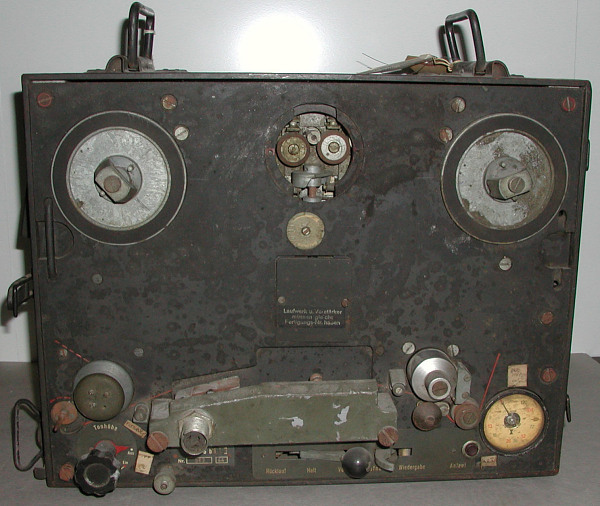
By the 1920s, the use of steel tape in magnetic recorders had begun to be researched and developed in England and Germany for use in cinema and broadcasting.1 However, steel tape was clumsy and dangerous to work with; inspired by this, and utilizing his knowledge with developing cigarette paper, Austrian inventor Fritz Pfleumer developed a magnetic tape made of iron oxide powder glued to paper.2 To promote his product commercially, Pfleumer partnered with German electronics group AEG, who in turn partnered with I.G. Farbenindustrie and their BASF division to handle chemical experimentation.3 Together, AEG and BASF produced their first magnetic phonograph, or “Magnetophon,” in 1934, and debuted it at the 1935 Berlin Radio Exhibition.4 As the Magnetophon began to hit the market and made its way into German broadcasting studios, the Wehrmacht began to also adopt the technology for their “Propaganda Corps” and other various usage cases.5 AEG, BASF, and the Wehrmacht continually improved upon the design of the Magnetophon as well as continually developed better magnetic tape formulas, specifically PVC coated tape, which became a German standard for many years after World War 2 ended.6 Despite the vast improvements in magnetic tape technology in Germany during the 1930s and 1940s, the technology remained very localized until the end of the war. US Army Signal Corps Captain James Menard wrote an assessment of the Magnetophon and its specifications in a 1946 report following their discovery in post-war Germany. In this report, Menard highlights the “excellent performance” of the Magnetophon, and lauds the “design and quality” of the tape drive system.7 In context with other magnetic tape recording devices from other countries, the Magnetophon represented an important step forward in tape technology. Menard went as far to surmise that:
The performance already achieved in the Magnetophon equipments in service, improved by the advances under development, leave little to be desired in a sound recording system. It is the opinion of the writer that the Germans have thoroughly exploited this field of recording, and have secured satisfactory answers to all the problems involved in this method, producing a truly superior recording system.8
With a new understanding of the technology surrounding magnetic tape recording, the US and other Allied countries were able to vastly improve their own systems of magnetic tape recording and bring to market a much better product, which brought forth even greater advancements in tape technology as devices utilizing the technology began to become more consumer focused in the post-war period.
- Friedrich Engel and Peter Hammar, “A Selected History of Magnetic Recording” (2006): 2. https://www.richardhess.com/tape/history/. ↩︎
- Engel and Hammar, “A Selected History of Magnetic Recording,” 2. ↩︎
- Engel and Hammar, “A Selected History of Magnetic Recording,” 2. ↩︎
- Engel and Hammar, “A Selected History of Magnetic Recording,” 3. ↩︎
- Engel and Hammar, “A Selected History of Magnetic Recording,” 5. ↩︎
- Engel and Hammar, “A Selected History of Magnetic Recording,” 7. ↩︎
- James Z. Menard, “High Frequency Magnetophon Magnetic Sound Recorders,” Field Information Agency, Technical 705, (1946): 5-8. ↩︎
- Ibid, 23. ↩︎
Leave a Reply