Video Transcript
[0:01] [Title card; 80s instrumental music starts playing; Inserting cassette into boombox] – The Tape That Made America
[0:10] [Instrumental music continues playing] Dr. Caffery: They were special because the Sony Walkman was just so cool.
[0:13] Melissa Phelps: They were just more accessible.
[0:15] Mr. Catlin: A mix-tape is its own art form.
[0:18] Dr. Caffery: I think it, like, it gave you so much choice.
[0:20] Melissa Phelps: It was easy to stick them in your bag and take them and share them with your friends and carry them with you.
[0:25] Mr. Catlin: Cassettes were how I understood music at the time.
[0:27] [Boombox visual reappears, fades to black, title fades, instrumental music fades]
[0:33] [Instrumental music comes back in, Narrator 1 appears on screen] Narrator 1: In 1962, in collaboration with Philips, Lou Ottens and a team of engineers invented the compact cassette tape, and changed the way we enjoy music forever. However, the cassette tape is the result of many years of innovation of magnetic tape technology. In fact, the cassette can trace its origins back by nearly three quarters of a century.
[0:55] Narrator 2: In 1898, Valdemar Poulsen, a Danish engineer, developed the first ever commercial magnetic recording device. He was attempting to create an early form of voicemail. He dubbed his device the ‘Telegraphone’, which recorded sound onto metal wire. Unfortunately, Poulsen and his team of engineers didn’t consider the possibility for their invention outside of the world of communication, and lacked the resources to market it successfully. This rendered the Telegraphone a commercial failure, and mostly overlooked.
[1:24] Narrator 1: However, the Telegraphone set a groundwork for magnetic recording technology, which would continue to be developed and experimented with for decades to come.
[1:33] Narrator 1: By the 1930s, magnetic tape recording technology had found its place in the European and American broadcasting industries. However, it still lacked necessary development to push it into mainstream use. Chiefly, magnetic recording devices used steel tape, which was difficult and dangerous to work with.
[1:52] Narrator 2: Fritz Pfleumer, an Austrian inventor and recording enthusiast, had initially developed a process for putting decorative metallic strips on cigarette paper. He figured he could use a similar process to design a newer, safer type of magnetic tape for recording machines. Working with German engineering and chemical companies, Pfleumer produced the first magnetic phonograph, dubbed the ‘Magnetophon’, in 1934.
[2:15] Narrator 1: German engineers continued to develop the Magnetophon throughout World War 2. This development made the Magnetophon the most advanced piece of magnetic tape recording technology for its time.
[2:26] Narrator 2: After it was discovered by the Allied Forces following German surrender, one US Army Officer described the magnetophon as a “truly superior recording system.” [Graphic with text appears on screen – “‘Truly superior recording system” – Capt. James Z. Menard”] The device was brought back to America, and reengineered into a number of commercial products that introduced tape recording technology to the home, and to mainstream consumers.
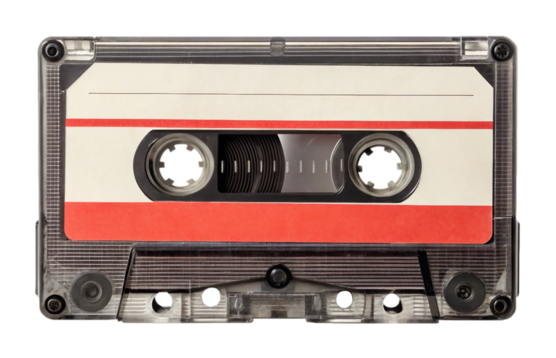
[2:43] [Transition: Cassette appears on screen with tape reels turning] [Section title: “RCA Sound Tape Cartriage”]
[2:49] [Section title card fades back, Narrator 1 reappears on screen] Narrator 1: One of those devices came about in the form of the RCA sound tape. In the late 1950s, the Radio Corporation of America (AKA RCA) wanted to revolutionize home audio with their Sound Tape Cartridge.
[3:03] Narrator 2: The cartridge bore a strong resemblance to what we know as the cassette tape. Unfortunately for RCA, the sound tape cartridge was not very popular. Its design was complicated, and it was difficult to manufacture. Despite these challenges, the sound tape cartridge represented the first real attempt at streamlining magnetic tape recording and playback into one, intuitive and straightforward piece of technology, with the added benefit of portability.
[3:28] [Transition: Cassette appears on screen with tape reels turning] [Section title appears: “The 8-Track Tape”]
[3:32] [Section title card fades into interview clip with Melissa Phelps appears on screen with text in the bottom left corner, “Melissa Phelps ‘child of the 80s’”] Phelps: We also had some 8-track tapes that my dad had so some of the music I listened to was on 8-tracks.
[3:38] [Narrator 1 reappears on screen] Narrator 1: When it came to portability, perhaps the most well known competitor and sibling of the cassette tape was the 8-Track tape. Interestingly, the 8-Track tape was developed after the first cassette tape was developed.
[3:51] Narrator 2: William Lear, founder of Learjet, redesigned a complicated 4-track tape cartridge used in his jets into a simpler, more expansive 8-track cartridge. Lear was able to lobby the Ford Motor Company to take the risk of including his cartridge system in their 1966 production model cars, which paid off. Two years later, nearly 2.5 million 8 track systems were in use across the US. However, the 8-track tape had numerous drawbacks. Primarily the inability to fast forward, rewind, and record.
[4:21] Narrator 1: Despite this, 8-track tapes remained the predominant form of portable music enjoyment until the late 1970s, when cassettes truly began to become a cultural icon.
[4:31] [Transition: Cassette appears on screen with tape reels turning] [Section title appears: “Inventing the Compact Cassette Tape”]
[4:35] [Section title card fades, Narrator 1 reappears on screen] Narrator 1: Lou Ottens was a Danish engineer and inventor, who is often credited as the sole inventor of the Compact Cassette tape. The cassette tape however, was never the work of one man alone.
[4:46] Narrator 3: In 1952, Ottens began to work for Philips. By 1960, he was leading the new product development division. A year later, his team introduced the compact cassette, a portable, plastic-encased alternative to the bulky reel-to-reel systems of the time.
[5:03] Narrator 1: Ottens always acknowledged that it was a team effort. Engineers in the city surrounding Philips’ development lab who were experienced in record and tape equipment joined to collaborate in the development process.
[5:15] Narrator 3: Before the cassette, the team launched the EL 3585 in 1958. The first battery-powered reel-to-reel recorder. Its success proved there was demand for something smaller, pocket-sized, and more affordable. Ottens’ group aimed to lower costs, reduce battery usage, and maintain consistent quality.
[5:34] Narrator 1: They wanted a recorder that could fit in a shirt pocket and worked with their existing Philips technology. Japanese competitors offered small rim-drive recorders, but they had poor quality and short battery life which in the end left space for Philips’ engineers to create a better product.
[5:50] Narrator 3: Philips initially considered partnering with RCA to use their tape cartridge system. But Lou Ottens saw a problem with that plan, the RCA design was too bulky and exposed too much tape.
[6:02] Narrator 1: The RCA cartridge had large recesses for the record and erase heads, leaving three exposed holes. Ottens’ team wanted minimal tape exposure, so they decided to create their own design. Only using RCA’s system as an inspiration. Ottens began by carving a wooden block small enough to fit in his jacket pocket, the blueprint for the first portable cassette recorder, the EL 3300.
[6:25] Narrator 3: In 1963, Philips introduced the Compact Cassette at the IFA [Text appears on screen: “IFA = Internationale Funk Ausseltung”] in Berlin. At first, the response was lukewarm, and only a few in the audio industry saw the cassette tape’s potential. But Philips made a bold move, they offered the patent for free to other manufacturers, including Sony and National, a part of Panasonic Corporation. This decision helped the Compact Cassette become the worldwide standard.
[6:51] Narrator 1: Through its countless proposals for tape sizes, speeds, and cartridge designs. Ottens and his team created the cassette tape, a product that revolutionized music and portability worldwide. The cassette tape owes its success to innovation, persistence, and a dream.
[7:07] [A woman jogging appears on screen. Text appears transitioning to the next section: “So Why Does It Matter?”. The woman takes out a Sony Walkman, skips to the next track, then jogs off screen.]
[7:17] [Video and text fades, Narrator 1 reappears on screen] Narrator 1: The introduction of the cassette has made a significant impact on popular American culture. We wouldn’t listen to and consume music today the same way without it. But what made them so successful?
[7:29] Narrator 4: The compact cassette set itself apart from its competitors. It was smaller in size and it was easier to carry around and listen to practically anywhere you went. It also allowed consumers to have more control over the kind of music they listened to, in a way they had rarely had before.
[7:43] [Interview clip with Dr. Kevin Caffrey appears on screen with text in the right corner: “Dr. Kevin Caffrey, UMW Senior Associate Registrar”] Dr. Caffrey: And you could just take music on the go and it was such a game changer when you went on road trips with your parents because you didn’t have phones [text disappears] and, you know, parents maybe weren’t as into talking to kids all day about their lives and stuff like that, so you were basically in the backseat for ten or twelve hours and all you had to listen to was your Walkman and whatever cassette tapes you took with you, so good memories of like that early time that you were able to take music out of your home and listen to.
[8:12] [Narrator 1 reappears on screen] Narrator 1: This greater bandwidth of mobility compared to something like the vinyl record resonated with consumers and was further amplified by the introduction of the Sony Walkman in 1979.
[8:23] [Interview clip with Dr. Kevin Caffrey appears on screen with text in the right corner: “Mr. Peter Catlin, UMW Research Librarian”] Mr. Catlin: But the thing about a Walkman is it lets you take music on the go. It had a pair of headphones, like if you could see those headphones they look goofy now, they had a lot of foam on them, but um, again, mid-90s.
[8:41] [Narrator 4 reappears on screen] Narrator 4: Created by Sony chairmen Masaru Ibuka and Akio Morita, the Walkman is just about the size of the cassette and is paired with headphones, allowing users to have complete control over the audio and music listening experience.
[8:54] Narrator 4: The Walkman was a major success, selling over 186 million units of the cassette version from the launch date in July 1979 to 1998, according to Sony.
[9:04] Narrator 1: The introduction of the Walkman is arguably what launched cassettes into the mainstream and solidified their place in the history of music and technology. However, the walkman was not without its competitors. In the late 1970s another piece of technology you may know and love was being developed – the compact disc.
[9:24] [Transition: Cassette appears on screen with tape reels turning] [Section title: “The Compact Disc (CD)”]
[9:28] [Section title card fades, Narrator 4 reappears on screen] Narrator 4: The compact disc, or CD, was developed by Royal Philips and Sony in the late 1970s and introduced to the public in 1982. The goal was to create a product that could hold more minutes of listening time than the cassette. Additionally, what made the CD different was that it took the concept of how a vinyl record has grooves that produce the sound of the music but greatly reduced the size using
Pulse Code Modulation. Along with the release of the CD player, the CD was massively successful with many sources crediting it as the most successful audio technology by the
1990s.
[10:02] Narrator 1: Sorry to our girl the cassette but the CD became very popular very quickly in the 80s and 90s. To be fair, people loved the CD for the same reasons they loved the cassette: it was small, it was portable, and it allowed people to have more control over their music listening experience. The battle is not done yet I’m afraid. It’s time to introduce the MP3.
[10:23] [Transition: Cassette appears on screen with tape reels turning] [Section title: “The MP3”]
[10:28] [Section title card fades, Narrator 1 reappears on screen] Narrator 1: The rise of the internet in the 90s and early 2000s opened up a new market. Buying, selling, and listening to music digitally had already been experimented with in the 1980s, but now it was really picking up.
[10:42] Narrator 4: In 1982, Frank Zappa was able to send music recordings over cable networks for consumers to record onto cassettes. In 1994, Jim Griffin sent downloads of an Aerosmith track to subscribers of CompuServe. However, digital files at this moment were far too big for computer hard drives to handle for this to be a successful alternative to something like the cassette.
In 1993, Karlheinz Brandenburg got an algorithm for digital music which was coined the MP3 approved by the Motion Picture Experts Group. The MP3 solves the problem of file size by removing excess sounds that aren’t as detectable to the human ear compared to louder, more prominent parts of the track.
[11:23] Narrator 1: Corporations were not very big fans of MP3s, because, well, capitalism, and more so because, like recording onto blank cassettes before, consumers could burn the digital recordings onto their own blank CDs.
MP3s had an edge over the cassette and CD because consumers now had something that held even more music and, if you had access to a computer, kind of cut out the middle man when it came to purchasing music. However, arguably, MP3s don’t out do cassettes in their cultural impact.
Have you ever made or listened to a playlist? It could be one you made for yourself, one a friend or partner made for you, one you found just perusing the internet. Did you know that without cassettes, playlists as we know them would not exist?
[12:06] [Transition: Cassette appears on screen with tape reels turning] [Section title: “Mixtapes, Impact, and the Future”]
[12:11] [Section title card fades, Narrator 4 reappears on screen] Narrator 4: Cassettes offered consumers a new way to listen to and control their music, specifically with the use of mixtapes. Mixtapes are just like a playlist you’ve probably made on Spotify or Apple Music, a collection of songs from various artists, just in the physical form of a cassette, and they allowed people to connect over music like never before.
[12:29] [Interview clip with Melissa Phelps appears on screen with text in the bottom left corner, “Melissa Phelps”] Phelps: We would make mixtapes. We would sit there and record off of the radio so we could really get all of our favorite music. [Text disappears] So, there was a large black music [market] for blank tapes and share tapes and if someone bought an album they would record it and share it with their friends.
[12:49] [Narrator 4 reappears on screen] Narrator 4: The mix-tape also gave smaller artists opportunities to share their music with a wider audience by recording their own tracks onto cassettes.
[12:57] [Interview clip with Dr. Kevin Caffrey appears on screen with text in the bottom left corner, “Dr. Kevin Caffrey”] Dr. Caffrey: I have a lot of good memories of like recording with friends or on my own and making these copies and sending them out, and of course, you get a rejection. [Text disappears] This was the only way you could get your music out there and you had to go physically give it to people and hope they didn’t throw it back.
[13:10] [Interview clip ends, Narrator 4 reappears on screen] Narrator 4: Mixtapes also helped launch one of the most culturally influential music genres in American history: hip hop. Mixtapes have and will continue to be an important part of hip hop as many significant artists, like Drake, got their start by releasing mixtapes and still release mixtapes in between album releases.
[13:28] Narrator 1: Despite digital music dominating the music industry today, there are many groups of young people who still enjoy listening to cassettes. Many popular artists today, like Billie Eilish, Taylor Swift, or Harry Styles, are releasing their latest work on cassette. Many metal and alt music groups never really stopped releasing new music on cassette. But will the cassette reach a new peak in popularity? We think yes.
But if we’re wrong, that doesn’t diminish the significant technological and cultural impact the cassette has made in the United States. If anything, the next time you hit play on your playlist, we hope you remember that you wouldn’t be doing that if it wasn’t for the cassette.
[14:08] [Transition to clip of Abby taking a cassette out of the boombox, energetic instrumental music plays]
[14:22] [Credits role as blooper reels play alongside]
Narrator 1: Abby Firestone
Narrator 2: CJ Nemetz
Narrator 3: Ashley Palin
Narrator 4: Grayson Donohoe
Runner: Ava Njore
Interviewees: Melissa Phelps, Mr. Peter Catlin, Dr. Kevin Caffrey
Scripting + Editing: Abby Firestone, Ashley Palin, CJ Nemetz, Grayson Donohoe
Special Thanks To: Dr. Jeff McClurken for his support and guidance. The HIST 325
Class of ‘25 … and to viewers like you. Thank you.