From its giant screens to its expensive ticket prices, IMAX has transformed how audiences experience movies and how filmmakers create them. Some moviegoers and directors alike prefer it over industry standards for its higher-quality imaging and sound system. But behind this is a long history of technological innovation and experimentation. A series of cinematic technologies that began as a solution to the limitations of early widescreen formats soon evolved into a popular and financially successful immersive experience. In this project, we will argue that IMAX reinvigorated the movie industry both culturally and economically.
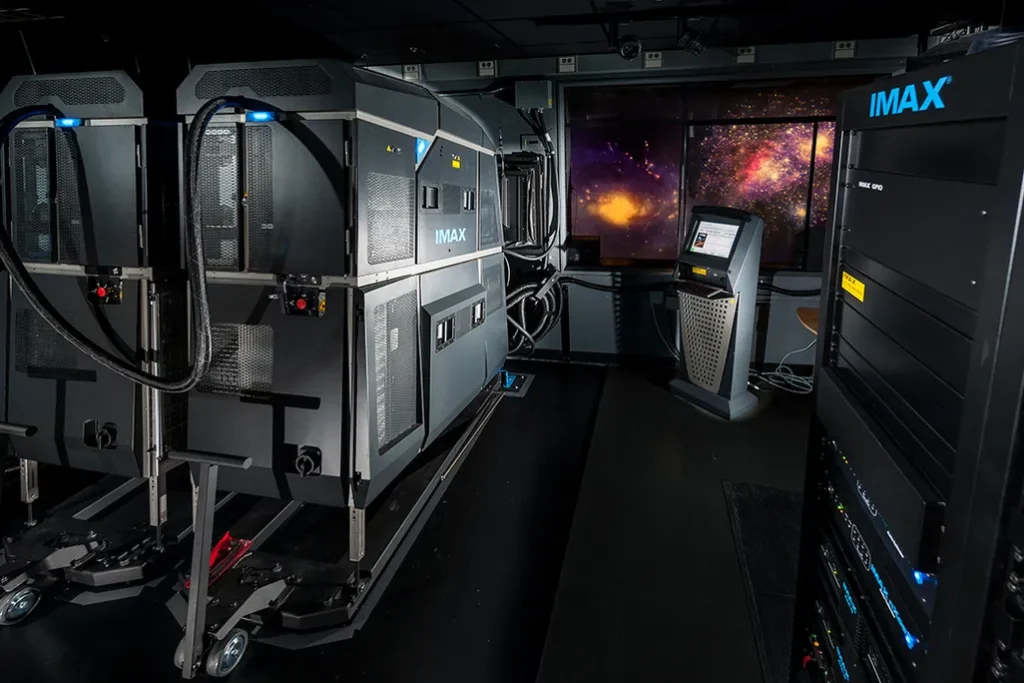
The IMAX system incorporates multiple forms of technology, including 15/70 mm film, specialized projectors, and a curved screen. While these technologies are unique to IMAX, they are offshoots of long-established standards in the film industry. For example, the original size of film is 35 mm and vertical, whereas the 70 mm film used in IMAX is significantly bigger and horizontal. This example, as well as other antecedents, will be explored on our website and in our documentary, as well as other projects that inspired the IMAX system. Several years before Multiscreen Corp. was established, several other companies in the early twentieth century attempted to create a new and larger film experience. Twentieth Century Fox, Cinemera, and Paramount all developed their own systems for large format films, all of which utilized multiple projectors and multiple screens. Roman Ferguson and Graeme Ferguson, hoping to enter the market, created their company, Multiscreen (later renamed to IMAX), but faced several technological challenges with the multiscreen format. Over the course of several years, they then streamlined the process into one camera, one projector, and one screen. While the other companies’ attempts had some public successes, the simplicity of the IMAX system has prevailed both economically and socially.
While IMAX has become increasingly popular in recent years, and sometimes the only way to watch films, it was initially popular in movie theaters. Its initial interactions with the American public were in museums, and it was used to show several films at the National Air and Space Museum. Over time, its ability to enhance the film product and the audience experience allowed the system to move into movie theaters. Its public success continued to grow and was only halted by the COVID-19 pandemic. In 2020, when the pandemic hit, movie theatres were heavily impacted and attendance reached an all-time low. People turned to watching movies through streaming apps from the comfort of their own homes. However, the intrigue and luxury experience of IMAX allowed for a resurgence in popularity and, in turn, revitalized the movie industry, even as attendance remains low. While IMAX continues to be a popular format for showing and shooting movies, it has also become an exclusive one. Filmmakers are starting to produce more and more movies purposefully for IMAX screens or re-releasing films exclusively for the IMAX format. IMAX has been a key source of revenue for theatres, which is something we hope to explore in this project.
Within our website, we aim to explore the creation of IMAX and analyze its impact on film and American culture. We will organize our website with a home page and assorted topic pages. The home page will provide a simple introduction to our artifact. It will feature visuals and a brief description of what IMAX is, as well as a concise overview of the topics we will cover on our website. For our pages, we will organize them by the following topics: artifacts’ antecedents, the process of inventing IMAX, alternatives, interactions with American society, and our documentary. On each page, we will aim to include a variety of visual examples, such as pictures and clips, to keep readers interested while also providing write-ups of our research. Our documentary will focus on the history of IMAX, as well as its current use in the film industry. The documentary will be formatted with both clips relating to IMAX and interviews. The interviews will be of ourselves and others to see individual experiences within IMAX. Throughout the documentary, the members of our group will be narrating and critically analyzing the creation and growth of IMAX. In our documentary, we will cover topics such as the antecedents, the invention, and interactions with American society. We will also be looking at direct examples of how IMAX is being used, through Christopher Nolan’s films and movie theatres such as AMC, which is promoting its IMAX experience for customers.
Our group has collectively decided that no use of AI will be necessary in our project, and we will only utilize it to the extent that websites (such as Google and JSTOR) require it. This will ensure that all of our work is our own and that we do not rely on it to give us information that might be false. For digital tools, we will utilize the DKC and Library resources, including the podcast studio, audio and video equipment, lights, and cameras, to make our documentary effective. Additionally, we will utilize DKC guides to help us improve our website, making it accessible and usable. Introductory and free video, audio, and graphic design editing software, such as Canva, Clipchamp, or Audacity, will be used during the documentary section of this project to create the video.
We decided to do our project on IMAX because we wanted to explore something related to movies, cameras, and theatre. IMAX was something we grew up attending, and we knew how important it was to the movie culture. Using our personal experiences can help us in this project by being “living history” for our project. Additionally, it is a significant technological development that has substantially changed the movie industry and American culture, providing us with numerous information sources to utilize for this project. Overall, this project is unique because it will show how technology can play a crucial role at an important time in history, helping to revive a previously dying cultural event or tradition. The transition into IMAX theaters and the new experience it brings to viewers has numerous effects, and we hope to explore multiple avenues to analyze how IMAX has contributed to the history of technology and development.