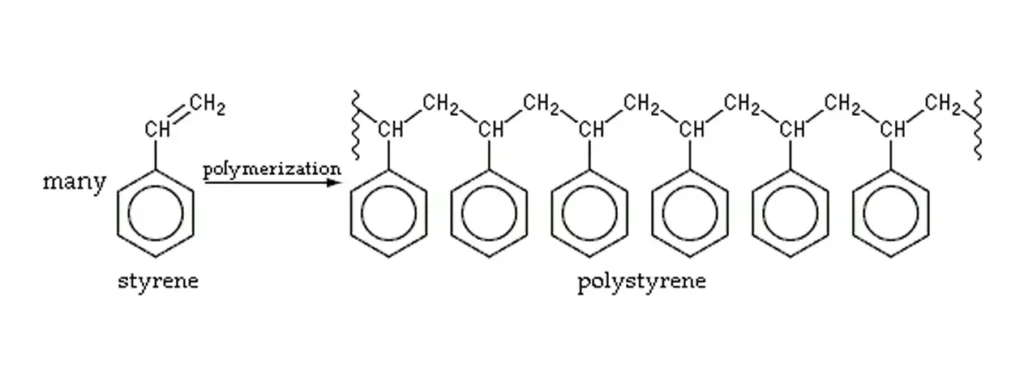
Polystyrene, more commonly known through the Dow Chemical trademark Styrofoam™, offers a fascinating case study in American technology and culture. At once a story of discovery, accident, and industrial transformation, polystyrene embodies the promise and the peril of modern innovation. Its history begins in the nineteenth century, develops through wartime necessity in the twentieth, and continues to shape economic, cultural, and environmental debates in the twenty-first. Our project will trace this material from its earliest antecedents to its present controversies, showing how one substance could so deeply influence American life.
Antecedents and Discovery
The story begins in 1839, when German apothecary Eduard Simon first isolated styrene from natural resin. Although Simon did not recognize the significance of his discovery, it laid the groundwork for later breakthroughs. In the 1920s, Hermann Staudinger, an organic chemist, advanced polymer theory by recognizing that long chains of styrene molecules could form plastics with properties similar to rubber. His theories, published in 1922, helped to explain why natural rubber had elasticity and why synthetic polymers could replicate it. By 1930, BASF had developed a method to commercially manufacture polystyrene, establishing its industrial potential.
The American story of polystyrene was shaped by World War II. Rubber shortages forced researchers to search for substitutes, and in this context, Dow engineer Ray McIntire attempted to create a flexible insulator by combining styrene and isobutylene. Instead, he stumbled upon something unexpected: a foam version of polystyrene that was thirty times lighter than the solid material and resistant to both water and heat. Dow secured rights to a process patented earlier by Swedish inventor Carl Munters, and in 1944, McIntire’s “accidental” invention was patented as Styrofoam.
Invention and Adoption
The appeal of polystyrene foam was immediate. It was inexpensive, lightweight, durable, water-resistant, and an excellent insulator. Competing materials—rubber, cardboard, glass—could not match the combination of properties Styrofoam offered. Dow Chemical marketed the product for construction, insulation, packaging, and marine uses. Before long, Styrofoam cups, takeout containers, and packaging became staples of American life. Styrofoam was not simply a new material; it was a symbol of postwar convenience, embodying the culture of modernity and disposability that characterized mid-twentieth-century consumer society.
Impact on Economy, Military, and Culture
Polystyrene’s economic impact remains significant. In 2024, the expanded polystyrene market in North America was valued at $17.82 billion, with projections reaching $29.04 billion by 2033. Its uses extend across construction, packaging, automotive, and consumer goods, where it contributes to cost savings and energy efficiency. In the military, foam has been used to protect equipment during transport and to enhance personal protective gear, including helmets and body armor. Its shock absorption and insulating qualities made it indispensable in both combat and supply chains.
Culturally, Styrofoam became woven into American daily life. From the mid-century diner coffee cup to the modern shipping box for electronics, polystyrene shaped expectations of convenience, safety, and disposability. It also influenced art and craft, becoming a material used by hobbyists, set designers, and even educators. Yet this cultural adoption came with an unintended cost: environmental and health concerns that persist to this day.
Problems and Controversies
Polystyrene does not biodegrade, breaking down instead into smaller and smaller pieces that become microplastics. These particles contaminate oceans, harm wildlife, and enter the human food chain. Recycling polystyrene has proven difficult and expensive, with most facilities refusing to process it. Studies have also raised concerns about styrene, a probable human carcinogen, leaching from containers into food and beverages. As a result, cities and states have enacted bans on Styrofoam food packaging, while environmental activists call for broader restrictions.
This dual legacy—convenience and harm—makes polystyrene a particularly relevant artifact for study. It represents not only the triumph of twentieth-century materials science but also the dilemmas of twenty-first-century sustainability.
Project Plan
Our group’s project will explore this dual legacy through a research site and a short documentary. The site will include a timeline of polystyrene’s development from 1839 to the present, thematic sections on invention, adoption, and cultural impact, and a section devoted to environmental controversies. The documentary will emphasize the human story of discovery and accident, showing how McIntire’s wartime research led to a material that changed American life. It will contrast the optimism of mid-century advertisements with the challenges of environmental pollution and recycling.
Digital Tools and AI Use
To produce the documentary, our group will use the University of Mary Washington’s Digital Knowledge Center, including access to its studio and professional equipment. We will also film in off-site locations to provide authentic visual material connected to our topic. For editing, we will use PowerDirector 365, which allows for advanced video production and integration of historical media. AI tools may assist with generating visual graphics, transcriptions, or subtitles, and any AI-generated content will be clearly identified according to course requirements.
Rationale
Our group chose polystyrene because it illustrates the complexity of technological progress. It is a product of scientific creativity, wartime necessity, and industrial expansion, yet it also stands as a reminder of the environmental costs of convenience. Polystyrene is an artifact that forces us to ask: what does it mean for a technology to succeed, and at what price? In exploring this question, our project aims to revive the history of Styrofoam while engaging the cultural debates that continue to shape its place in American life.
Annotated Bibliography
- McIntire, Otis Ray. Foam Polystyrene and Method of Making Same. U.S. Patent 2,450,436. Filed December 14, 1944, and issued October 5, 1948.
– The original patent for foam polystyrene, documenting McIntire’s process and Dow’s ownership of Styrofoam. - Dow Chemical Company. Styrofoam™ Brand Insulation Advertisements, 1940s–1950s. Various print ads.
– Early advertisements that promoted Styrofoam as modern and practical, revealing how Dow shaped consumer adoption. - Staudinger, Hermann. “Über Polymerisation.” Berichte der Deutschen Chemischen Gesellschaft 55, no. 6 (1922): 1073–1085.
– Foundational article introducing polymer theory, crucial for understanding the chemistry behind polystyrene. - Science History Institute. “Styrofoam, a Practical and Problematic Creation.” Science History Institute, April 27, 2020. https://www.sciencehistory.org/stories/magazine/styrofoam-a-practical-and-problematic-creation.
– Overview of Styrofoam’s invention and cultural legacy, emphasizing its dual role as both useful and problematic. - Grand View Research. “Expanded Polystyrene (EPS) Market Size, Share & Trends Report, 2024–2033.” Grand View Research, 2024.
– Market analysis providing data on the economic scale and growth projections of polystyrene. - Lane, Kris. The Environmental History of Plastics: Technology, Culture, and Sustainability. Cambridge: Cambridge University Press, 2019.
– Scholarly study placing polystyrene within the broader history of plastics and environmental debates. - Andrady, Anthony L. Plastics and the Environment. Hoboken: John Wiley & Sons, 2003.
– Examines plastics’ environmental effects, with sections on polystyrene and its contribution to microplastics. - Meikle, Jeffrey L. American Plastic: A Cultural History. New Brunswick: Rutgers University Press, 1995.
– Classic cultural history of plastics, useful for contextualizing Styrofoam in mid-century American life. - “Why Is Styrofoam Still a Popular Packaging Material?” Custom Designs Boxes Blog. Accessed September 2025. https://customdesignsboxes.com/blog/why-is-styrofoam-still-a-popular-packaging-material.
– Industry-oriented article explaining why Styrofoam remains widely used in packaging. - Alta Max LLC. “Packaging Foam: A Military Essential.” Altamax.net. Accessed September 2025. https://www.altamax.net/packaging-foam-a-military-essential.
– Details military applications of foam in helmets, armor, and packaging. - Beyond Plastics. “Fact Sheet: Polystyrene.” BeyondPlastics.org. Accessed September 2025. https://www.beyondplastics.org/fact-sheets/polystyrene.
– Advocacy source summarizing environmental and health concerns with polystyrene. - Environment America. “The Problem with Polystyrene Foam.” Environment America – Oregon Campaigns. Accessed September 2025. https://environmentamerica.org/oregon/articles/problem-polystyrene-foam.
– Outlines health risks and environmental impacts, supporting regulatory debates. - Sustainable Business Magazine. “Is Styrofoam Toxic or Safe? Understanding the Hazards of Polystyrene.” Sustainable Business Magazine, 2024. https://sustainablebusinessmagazine.net/eco-review/is-styrofoam-toxic-or-safe-understanding-the-hazards-of-polystyrene.
– Examines toxicological concerns about styrene exposure in polystyrene. - NASA. “Foam and Cork Insulation Protects Deep Space Rocket from Fire and Ice.” NASA.gov, November 2018. https://www.nasa.gov/missions/artemis/orion/foam-and-cork-insulation-protects-deep-space-rocket-from-fire-and-ice/.
– Describes foam insulation in space exploration, highlighting advanced applications. - Bioprocess Online. “Mission Possible: Polystyrene Particles Facilitate Cellular Research in Space.” Bioprocess Online, March 2021. https://www.bioprocessonline.com/doc/mission-possible-polystyrene-particles-facili-0001.
– Details NASA’s use of polystyrene particles in microgravity biomedical research.
No responses yet