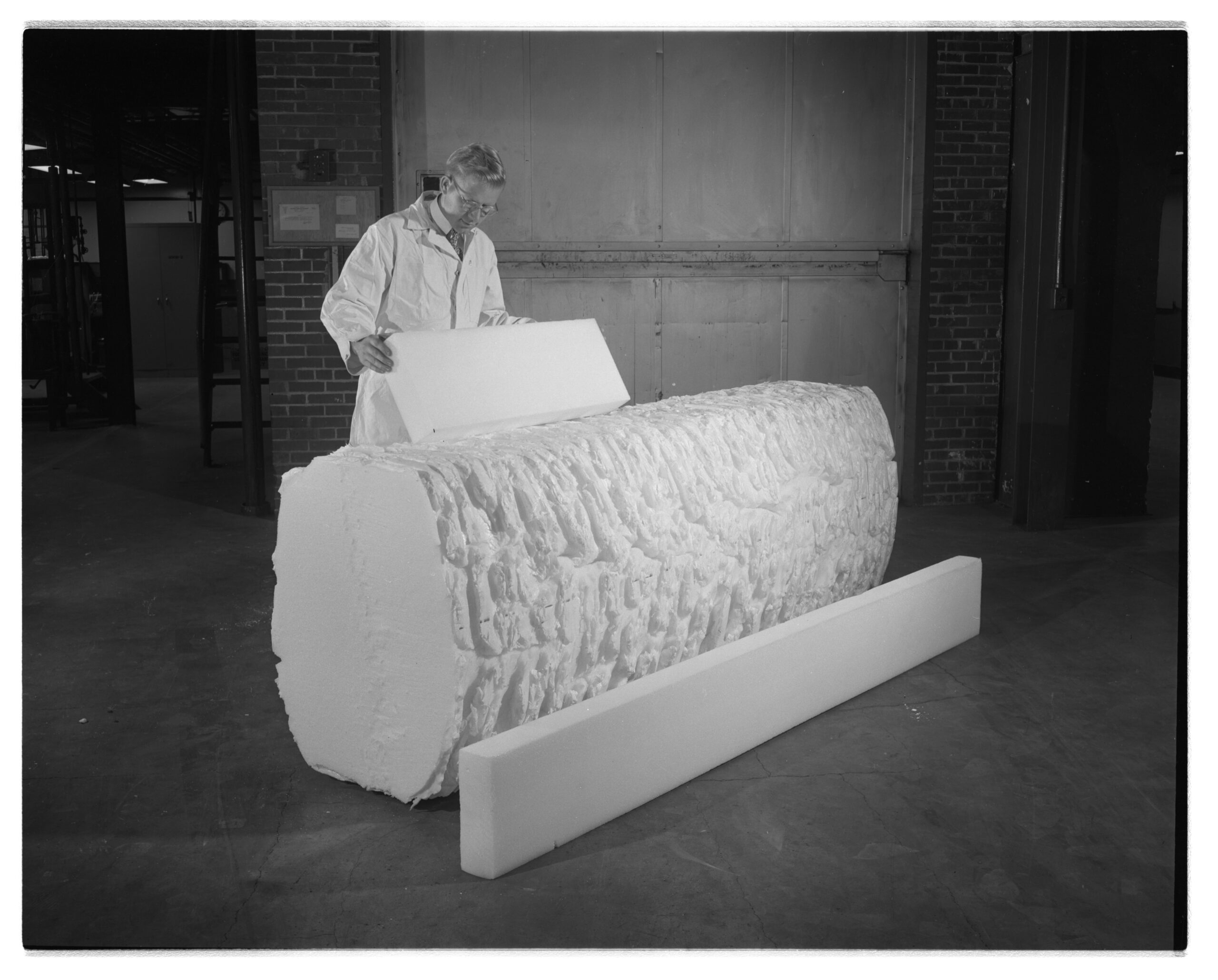
Documentary Outline
“Polystyrene: From War to Waste and Beyond”
I. Introduction – The Material that Shaped Modern America
- Opening visual: Archival footage of WWII manufacturing lines and consumer packaging.
- Narration focus: Introduce polystyrene as a product of innovation, born from wartime necessity, that transformed industries and daily life.
- Context: Briefly trace discovery by Eduard Simon (1839) and refinement by Ray McIntire at Dow Chemical during WWII.
- Thesis statement: What began as a military innovation evolved into a ubiquitous material touching defense, safety, space exploration, and food preservation—leaving behind both cultural convenience and environmental consequence.
II. Military Applications – The Wartime Catalyst
- Historical background: WWII rubber shortages and search for substitutes.
- Focus: Ray McIntire’s accidental creation of foam polystyrene; adoption for insulation, flotation devices, and protective packaging of military equipment.
- Visuals: Wartime footage, factory production scenes, patent documents.
- Significance: Demonstrate how military research laid the foundation for postwar consumer adaptation.
III. Safety and Industrial Applications – Protecting Lives and Machines
- Examples: Safety helmets, construction insulation, impact-absorbent materials.
- Narration: Emphasize technological confidence in plastics as durable, lightweight, and affordable.
- Visuals: Construction sites, laboratory drop tests, 1950s safety advertisements.
- Cultural connection: The postwar belief that synthetics symbolized progress and security.
IV. Packaging Revolution – The Consumer Boom
- Theme: How polystyrene became central to the American consumer economy.
- Examples: Disposable cups, trays, and shipping containers; rise of fast-food convenience.
- Narration cue: Link mass production to postwar prosperity and domestic culture.
- Visuals: 1950s-1960s commercials, supermarket aisles, assembly lines.
V. NASA and the Space Age – Polystyrene Beyond Earth
- Focus: Use in spacecraft insulation, lightweight instrument housings, and experimental materials for zero-gravity environments.
- Visuals: NASA archival footage, Apollo and Shuttle imagery.
- Narration: Connect technological ambition with the adaptability of synthetic materials.
- Broader point: Innovation in one field accelerated breakthroughs across others—symbolizing American ingenuity.
VI. Food Preservation – Extending Shelf Life
- Science segment: Explain insulating and non-reactive properties that revolutionized refrigeration, food transport, and take-out culture.
- Visuals: Laboratory experiments, refrigerators, early microwavable containers.
- Cultural tie: The convenience economy and the emergence of “disposable dining.”
VII. Health and Environmental Concerns – The Price of Progress
- Key issues: Styrene exposure, toxicity studies, worker safety regulations.
- Narration: Introduce debates over microplastics and long-term health impact.
- Visuals: News reports, EPA documents, interviews with scientists or historians.
- Contrast: Scientific innovation vs. unforeseen human cost.
VIII. Disposal and Recycling – From Utility to Sustainability
- Focus: The challenges of biodegradability, landfill accumulation, and recycling limitations.
- Visuals: Landfills, recycling plants, environmental cleanup footage.
- Solutions: Emerging biodegradable alternatives and circular-economy initiatives.
- Narration cue: End with a question: how do we balance convenience, safety, and sustainability?
IX. Conclusion – Reflection and Legacy
- Summary: Revisit how polystyrene mirrors American culture innovation, abundance, and consequence.
- Closing narration: “From the battlefields of World War II to the kitchens and orbiting spacecraft of today, polystyrene tells a story of invention’s promise and the responsibilities it leaves behind.”
- Visuals: Montage transitioning from historical footage to modern recycling efforts.
- Credits: Group acknowledgments, UMW Digital Knowledge Center, and PowerDirector 365 production.
No responses yet